AI is fundamentally reshaping consumer decision-making and, therefore, by association, the very core of marketing itself. But Jon (CEO & Founder of The Liberty Guild), says this is being ignored. Here he talks about why this is and what brands need to do about it.
Q> You’ve been talking about something called the “Generative Moment of Truth.” What do you mean by that?
Jon> The Generative Moment of Truth, or GMOT, is the point at which a machine collapses the consideration set and makes the decision on behalf of the customer.
For the past decade, marketing has been built around the Zero Moment of Truth, or ZMOT. That was the moment when a customer researched, compared, and decided before ever speaking to a brand. It gave us a coherent model for the internet age, search mattered, reviews mattered, and being visible at the right time mattered.
But that model relied on the core assumption that the customer did the work. And that assumption is now breaking.
Q> Breaking how? Isn’t this just an evolution of ZMOT?
Jon> No, it’s a replacement.
The act of researching, comparing, and selecting is being delegated to systems. Not occasionally, but habitually. Travel gets booked through agents. Products get sourced through assistants. Instead of building a shortlist, we’re handed an answer.
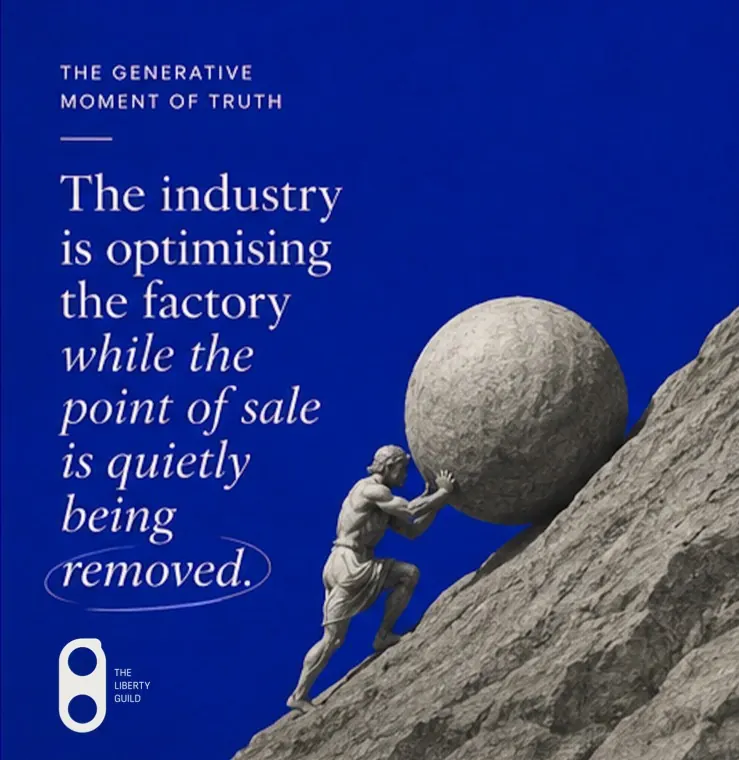
And yet the industry is obsessed with optimising the wrong layer. We’re industrialising content - faster, cheaper, more of it - while the place where decisions actually happen is disappearing.
We’re perfecting the factory while the shop floor is being ripped out.
That’s the shift. The decision is no longer being assembled by the customer. It’s being made for them.
Q> Why do you think the industry hasn’t fully clocked it yet?
Jon> Because it’s more comfortable to talk about productivity than it is to confront relevance.
AI as an efficiency play is easy to understand. AI, as something that reduces the surface area of marketing itself, is much harder to deal with.
But that’s what’s happening. The decision-making layer is being reconfigured. And that changes everything.
Q> So what actually changes for brands in this new model?
Jon> The shift is from visibility to eligibility.
Under ZMOT, your job was to show up, to be visible, to enter the consideration set and to compete within it. The customer would do the work from there.
Under GMOT, that set is often created before the customer even arrives. The system returns an answer, maybe two, but rarely more. If you’re not in that answer, you’re not competing. You’re absent.
So the question is no longer “can you be found?” It’s “can you be selected?”
Q> What determines whether a brand gets selected?
Jon> Three things, increasingly.
First, clarity. Can a model understand what you are, quickly and cleanly? If your product can’t be easily defined, compared, and justified in a sentence, you’re already at a disadvantage.
Second, consistency. Models don’t just read your website, they synthesise across the open web. Reviews, editorial, forums, structured data. If those signals are fragmented or contradictory, you become harder to trust and therefore harder to return.
Third, credibility. And this is the uncomfortable bit. Brands and agencies don’t control this anymore. Websites describes a brand/product/offering, they don’t validate it. Validation happens elsewhere, on places such as Reddit, in press coverage, on Wikipedia, across third-party sources.
So brands need to start thinking less about what they say, and more about what is said about them, and whether it aligns.
Q> That suggests a very different kind of marketing playbook…
Jon> It does. And it’s already emerging.
You need to design your brand for machine readability, not just human persuasion. That means sharper definitions, cleaner comparisons, more structured information.
You need to actively build third-party validation, not just coverage, but consistency across sources. PR becomes more important, not less, because it feeds the system.
And you need to rethink positioning. Not as broad, emotive territory, but as something operational. “Best for X in Y context” is far more useful to a system than “innovative” or “premium.”
This is less about storytelling in isolation, and more about making your story legible, provable, and repeatable across the ecosystem.
Q> What about brand positioning more broadly? Does that change too?
Jon> It tightens - often uncomfortably.
For years, brands have tried to stretch - appeal to as many audiences as possible, own broad territories. But systems don’t work like that. They need specificity.
The clearer and narrower your role, the easier it is to include you in an answer.
So you’re seeing a shift from ‘we do everything’ to “we are the best choice for this specific need, in this specific context.”
That’s not a branding tweak. That’s a structural change.
Q> And what does this mean for the traditional marketing funnel?
Jon> It starts to collapse. The unit of competition is no longer the search results page -it’s the answer itself.
In a generative interface, there often isn’t a long journey. No browsing, no comparison, no extended persuasion. The process resolves at the point of answer. So a lot of what we think of as marketing - capturing attention, nurturing interest, converting over time- has less room to operate.
You don’t get to persuade. You either make the set, or you don’t.
Q> That sounds quite stark. Are brands underestimating the scale of change?
Jon> Completely.
Most organisations are still optimising for a world where customers browse, compare, and decide. But that world is ending.
The more relevant question now isn’t how to be seen—it’s whether you’re even available to be selected.
And very few brands are set up for that today.
Q> So what happens to brands that don’t adapt?
Jon> They don’t lose. They disappear.
When a system is asked to decide, it won’t return ten options. It will return a handful. If you’re not among them, there’s no journey left to influence, no funnel left to optimise, no decision left to win.
You’re not being outperformed.
You’re simply forgotten.
This article first appeared in Little Black Book Online, 16.06.25. You can read the full article here: https://lbbonline.com/news/The-Generative-Moment-of-Truth-Why-Brands-Risk-Being-Forgotten